Lahore, the cultural capital of Pakistan, is considered to be the heart of the country. The city is a good combination of past and present, traditions and modernization, culture and hip hop. The city is full of historical monuments, museums, parks, shopping areas and modern architecture. A tourist might need weeks to discover Lahore. There are hotels of all standards available for tourists in the city. It is highly recommended that those Pakistanis who can afford to visit just one place, should opt for Lahore. It is a common saying that “Jinnay Lahore nahi takya au jamya hi nahi” (The one who has not seen Lahore, is yet to be born). Even if the history and historical monuments in Lahore are properly protected and taken care off, the city can attract as many international tourists as Rome, London, Cairo or Delhi etc. It is strongly advised the city should not be visited in summers, as it is extremely hot and humid. The following are few of the tourist attractions of the provincial capital of the Punjab:
1) Minar-i-Pakistan
Right beside the newly constructed Azadi chowk interchange and in the center of the Iqbal Park, stands a tall monumental minaret called the Minar-e-Pakistan, also known as the Eiffel tower of Pakistan. The monument was built in commemoration of the Lahore Resolution, passed by the Muslim League on March 24, 1940 on this very site, demanding the creation of separate state for the Muslims of the subcontinent. Each part of this building is a self-narration of the history of this particular event and the Muslim’s struggle for Pakistan.
This beautiful monument was designed and supervised by Nasreddin Murat Khan and Abdur Rehman. The foundation was laid on March 23, 1960 and it took eight years to complete it. The minaret reflects a blend of Mughal and modern architecture and is representative of the spirit of the Pakistan movement. The overall height of the structure is approximately 60 meters. The platform of the structure takes the shape five pointed star, enclosed in a crescent shaped pool. The base of the minaret is raised approx. 4 meters from the ground and forms a sculpted, flower like shape. From this point beyond, it tapers as it rises. It is constructed of reinforced concrete with the walls and floor made of stone and marble. The base comprises of four platforms. The lower portion is made of uncut Taxila Stone that indicates the initial tough days of independence and the humble beginning, the second portion is made of hammer dressed stones whereas the third and upper most portion is constructed of smooth chiseled marble pointing towards the success of the Pakistan Movement and gradual development and prosperity of the country. At the base and all around the minaret are placed ten marble slabs with 99 names of Allah written. Other inscriptions include excerpts from the speeches of Quaid-e-Azam, national Anthem and verses from Iqbal in Urdu and Bengali. In addition, various Quranic verses have been inscribed on the walls and main entrance of the Minar. Leading to the top of the minaret, are 324 stairs and a lift. The first balcony is 30 feet high and the second is at 50 feet. However, the top of the minaret is closed for the general public due to the increase suicide rate from the top of the building. Moreover, a separate ‘Chabootra’ of about 12 feet height is also constructed at some distance from the minaret with the inscription of Quranic verses.
The Park around the minaret is a lush green garden with fountains and artificial lake. Also, at the courtyard of the monument is the resting place of Hafeez Jalandari, the writer of Pakistan’s National anthem. A huge number of people visit the park both because of its historical significance and for entertainment purpose on daily basis between 9 AM and 9 PM.
2) Badshahi Masjid
Symbolizing the beauty, passion and magnificence of the Mughal era, the Badshahi Mosque is Lahore’s one of the most famous landmarks and a major tourist attraction. It is located right next to Minar-i-Pakistan and it hardly takes ten minutes to cover the distance on foot. It is the second largest mosque in Pakistan and South Asia, and the fifth largest in the world. The mosque is capable of accommodating 5000 worshippers in its main hall and a further 95,000 in the courtyard and the porticoes. Inside the main entrance, on first floor of Eastern Corridor there is also a small museum established by the Government of Pakistan. It contains relics of Prophet Muhammad SAW, his Son in Law Hazrat Ali RA & daughter Hazrat Farima RA. The museum contains a turban and hair of the Prophet Muhammad (saw), a turban of Hazrat Ali (ra) and other incredibly moving items for Muslims.
The Badshahi Mosque was built by the Mughal emperor Aurangzeb in 1671 under the direction of Muzaffar Hussain and completed in duration of three years. It is one of the most significant architectural monuments built during that era. The building was originally planned as a Shrine to protect a strand of the Prophet’s hair but was later turned into a mosque. The prominence of the mosque in imperial vision was such that it was constructed just a few hundred meters from the Lahore fort and the space between the fort and the mosque was used as a parade ground where Aurangzeb would review his troops and courtiers.
The architecture of the mosque is a mix of Islamic, Indian, Persian and central Asian design and is similar to the Jama Masjid (Delhi), also build by Emperor Aurangzeb. The interior of the mosque has rich embellishment in stucco tracery (Manbatkari) and the paneling is inserted with marble, with a fresco touch whereas the exterior is adorned with stone carvings and marble inlay on red sandstone. The skyline of the mosque is furnished with beautiful ornamental merlons inlaid with marble lining, which further adds to the beauty of the mosque. The various features of the mosque e.g. the courtyard, side aisles, four minarets, prayer chambers etc. are enumerated with the history of mosque architecture development of the Mughal era before 1673. The walls of the Badshahi Masjid are built with small kiln-burnt bricks laid with kankar.
The prayer chamber of the mosque is deep and divided into seven compartments by rich engraved arches carried on very heavy piers. The steps leading to this chamber and its podium are laid in multicolored marble. Of the seven compartments, three have double domes finished in marble while the rest have curvilinear domes with a central rib in their interior and a flat roof above. The structure is structured in such a way that the sound of the Azan in any of these compartments can be heard in the entire mosque without any voice amplifier.
During the Sikh rule of Maharaja Ranjit Singh, the mosque’ courtyard was used as a stable and the hujras around the perimeter were occupied by the soldiers. The mosque was also used as an exercise ground for the Sipahi Infantry. During the same era, Lahore was struck by a moderate earthquake which collapsed the delicate marble turrets at the top of each minaret.
After the British took control of Lahore in 1846, the mosque was still used as a military garrison; however, in 1852 it was handed over to the Badshahi Mosque Authority by the British to direct the restoration of the mosque and was later returned to Muslims for worship. The repair and restoration of the mosque continued until 1960.
Entry to the mosque is free and it remains open for the tourist and religious visitors from sunrise to sunset. People from all religions are allowed to enter the mosque however, only modest dressing is allowed. Shorts, sleeveless etc. inside the mosque are strictly prohibited. Shoes are also not allowed in the mosque area.
3) Mazar-i-Iqbal
Besides the majestic Badshahi Masjib in the Hazuri Bagh, lays the resting place of Dr. Allama Muhammad Iqbal, the great poet, philosopher and thinker of the subcontinent. Besides the historical significance of the mazar, it is also important from architectural point of view. Designed by an Afghani architect Nawab Zain Yar Jang Bahadur, the tomb is a mixture of Afghani and Moorish architecture. The Mazar is constructed of red sandstone and is a simple yet impressive structure. The rectangular shaped mausoleum has two entrance ways, one on the eastern and the other on the western side. Both the entrances are inlaid with marble. The grave is made with beautiful white marble that was presented as a gift by Afghanistan whereas; the gravestone is made of lapis lazuli (a deep blue semi-precious stone) with Quranic verses engraved in calligraphy. On the inside of the walls, six couplets of Iqbal’s Persian psalm, Zabur-e-Ajam are carved. The red stone used on the outside of the mazar is brought from Rajputana, India. Also, on the outside, there is a small yet beautiful garden that is distributed into small pots.
The entry to the mazar is free and it remains open for the general public though out the day.
4) Shahi Qila
To the northwestern side of the walled city and right in front of Badshahi Mosque, stand one of the oldest and the most magnificent architectural artistry of the Mughal era, Shahi Qila or Lahore fort. The Lahore fort covers an area of more than 20 hectares of the land and within this space it gives a complete narration of the rise and fall of the Mughals, the Sikh and the British rule. In 1981, it was also enlisted in the UNESCO World Heritage Site. The fort is one of the better maintained historical monuments in the city. To many, Lahore fort is even a better place to visit in comparison with Agra Fort and Red Fort, Delhi.
Although its origin is ambiguous yet according to some records it was constructed on the bank of river Ravi during the days of the Mughal emperor Akbar. Jahangir extended the construction, but it was during the days of Shah Jehan that esthetic touch was given to an otherwise crude building. The archeological department, Government of Pakistan, is trying its best to maintain that huge monument.
The fort has been divided into various notable structures and monuments reflecting the architectural styles of Emperor Akbar to Aurangzeb. Following are the few examples:
Akbari Gate
The Akbari Gate, also known as the Masti Gate was built by Akbar In around 1566 A.D. The word Masti was derived from Maseet, which means Mosque. It was named so because of the Mosque built outside this gate in 1614 A.D. The fort of Akbar originally had two gates, one being the Masti gate and the other was replaced by the the Alamgiri gate in 1673 A.D.
Alamgiri Gate
The Alamgiri gate was built for the military purpose and was built by Emperor Aurangzeb Alamgir in 1673 A.D. It has two semi-circular bastions that are decorated with lotus petal designs at the base. The gate opens in the Hazoori Bagh and illustrates a blend of vigor and majesty.
Diwan e Aam
In the fourteenth year of his rule, Shah Jahan constructed the hall of forty pillars for the general public. This building was warped when the Sikh Emperor bombarded on the fort while fighting against the widow of Kharak Singh. It was later reformed by the British after it was occupied by the British in 1849 A.D. The marble work in the Balcony of the Diwan is amongst the earliest structures in the Shahi Qila.
Diwan e Khas
The Diwan e Khas is an arched marquee, built completely with semi-chaste marble with its walls being fashioned with pietra dura work. There are also carved marble screens with a marble cistern in the middle. It was constructed by Shah Jahan in 1645 A.D.
Jahangir’s Quadrangle
The Jahangir’s quadrangle is built on the Hindu temple design. On the east and west of the building, there are rows of dalans (porticos) encircling it. The red sandstone front of the porticos is carved with rich Hindu art depicting drawings of animal figures. In the center of the north region lies Jahangir’s sleeping space which also has a square marble Mahtabi (platform) placed in the middle for the music and dancing purposes. This sleeping room is currently being used as the Mughal Museum. The Quadrangle was started in Akbar’s reign but completed by Jahangir in 1618 A.D.
Khawabgah of Shah Jahan
Situated at the southern end of the Shah Jahan’s Quadrangle, the khawabgah comprises of five chambers pierced with screens, clad in white marble. The chiseled galib kari and stucco tracery work on the arches of the building are the main features of this building. Some wall paintings can also be seen on the interior of the khawabgah. It was built by Shah Jahan in 1633 A.D.
Makteeb Khana
Standing towards the north-west corner of the Diwan e Aam and in the forecourt of Jahangir’s palace, the makteeb khana was the entrance gate by Muharrirs (Clerks). It was built by the emperor Jahangir in 1617-1618 A.D.
Moti Masjid
It is one of the three mosques built by Shah Jahan in Lahore fort, Agra Fort and Red fort Dehli. They all are called Moti Masjid because of the white marble used to make them. The Sikh rulers also used this masjid at treasury and named it as Moti Mandar.
Lal Burj
The lal burj is a three storied building standing adjacent to the Diwan e Khas and at the corner of the Shah Jahan’s Quadrangle. The structure was started by Jahangir and completed by Shah Jahan, however, the upper most part was the Sikh addition to the architecture. The exterior is made with tile mosaic and filigree work whereas the interior is decorated with beautiful fresco paintings.
Kala Burj
The Kala Burj is like the Lal Burj and was also used as a summer pavilion. The topmost part of the tower was used as bar by the British. The chhajji (roof top) is made with interlocked brick work.
Hammam e Shahi
Built on the Turkish architecture, the hammam was built by Shah Jahan adjacent to the Shah Jahan’s Khawabgah. It comprised of a Jama Khana, dressing room and was facilitated with warm water.
Paien Bagh
The Paien Bagh was built for the royal ladies for their health and recreation purposes. In the garden, there are paved bath, also, there is a water basin in the middle of a Podium built with beautiful brick work.
Hathi Paer
As the name suggests the Hathi paer was built by Shah Jahan for the elephants carrying the royals, to and fro the palace. It starts at the hathi paer and ends at the shish mahal. It has a total of 58 low and broad steps with 216 inches length and 8 feet 8 inches width.
Khilwat Khana
The Khilwat Khana is located at the northern side of the paen bagh. it was built by Shah Jahan. The base and door frames of the building are made with white marbles and the roof is curvilinear in shape.
Ath Darra
The Ath dara was the court area during the Sikh rule. It was built by Maharaja Ranjit Singh. It has eight doors, thus the name Ath Dara. The court is decorated with beautiful wall paintings and the art reflects the style of Kangra School of Painting. The ceilings are embroidered with beautiful wood and mirror work. The ath dara is constructed at the original entrance of the Shish Mahal.
The Badshahi Mosque is a Mughal-era congregational mosque in Lahore, capital of the Pakistani province of Punjab, Pakistan. The mosque is located west of Lahore Fort along the outskirts of the Walled City of Lahore, and is widely considered to be one of Lahore’s most iconic landmarks.
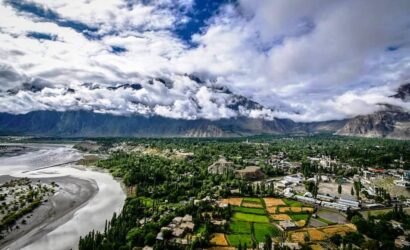
Hunza is a mountainous valley in the northern part of the Gilgit-Baltistan region of Pakistan. It is situated on the bank of Hunza river, bordering Ishkoman to the northwest, Shigar to the southeast, Afghanistan’s Wakhan Corridor to the north, and the Xinjiang region of China to the northeast
Naran is a town and popular tourist destination in upper Kaghan Valley in Mansehra District of Khyber Pakhtunkhwa province of Pakistan. It is located 119 kilometers from Mansehra city at the altitude of 2,409 meters.It is located about 65 kilometers away from Babusar Top.
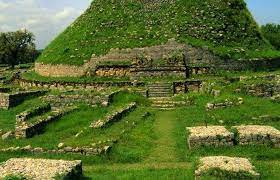
Taxila is a significant archaeological site in the modern city of the same name in Punjab, Pakistan. It lies about 25 km northwest of Islamabad and Rawalpindi, and 25 km southwest of Haripur, Khyber Pakhtunkhwa, just off the famous Grand Trunk Road.